Construction and demolition (C&D) activities generate a sizeable but often overlooked stream of plastic waste – roughly 1 % of total C&D waste, yet amounting to ≈ 2 million ton year⁻¹ in Europe. Recycling rates are low because collection schemes, market demand and regulatory frameworks are fragmented. The APPRICOD project piloted selective collection schemes in four European regions, revealing cost drivers, practical sorting methods, and the need for coordinated action among constructors, recyclers, and public authorities.
Plastic waste in the Construction and Demolition sector – scale and composition
- Overall quantities – EU‑15 produces ≈ 180 Mt C&D waste/yr (≈ 480 kg inh⁻¹). Plastics amount to only ≈ 1 % of this mass but represent ≈ 8.7 Mt of plastics used in construction (2004) .
- Material breakdown – Packaging 37 %, Construction 20 % (≈ 8.7 Mt), other sectors share the remainder.
- Dominant polymers – PVC ≈ 55 % of the C&D‑plastic resin mix, followed by PE (LDPE/HDPE) ≈ 30 %, EPS/XPS ≈ 15 % and minor fractions (PP, PU, PA, etc.) .
| Type of Plastics | Share of C&D Plastic Waste |
|---|---|
| PVC | 55 % |
| PE (LDPE/HDPE) | 30 % |
| EPS / XPS | 15 % |
| Others (PP, PU, PA…) | < 5 % |
Key insight: PVC dominates because it is used for pipes, window frames and flooring; its recycling pathway therefore dictates overall performance.
Recycling routes and technologies
- Mechanical recycling – shredding, washing, extrusion to produce re‑granulates; feasible when waste is clean and abundant (e.g., PVC windows, floorings).
- Feedstock (chemical) recycling – depolymerisation to monomers; suited for mixed, contaminated streams but requires high‑investment plants.
- Energy recovery – last‑resort for non‑recyclable plastics (e.g., incineration with heat recovery).
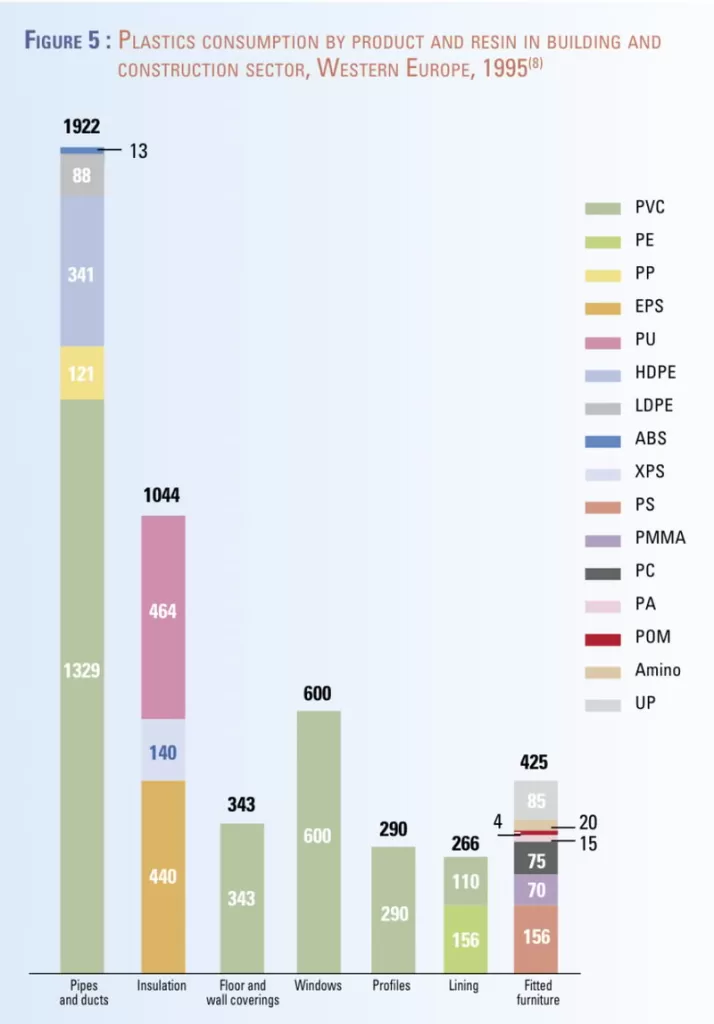
Practical tip: For hard PVC (windows, pipes) mechanical recycling yields a regenerated PVC compound that can be sold ≈ 5 % cheaper than virgin PVC, but colour may vary (Fig. 5) .
Pilot projects – scenarios, costs and outcomes
| Region | Main scenario | Typical collection method | Extra cost (€/t plastic) |
|---|---|---|---|
| Brussels (Belgium) | Separate hard + soft plastics on‑site; big‑bag collection | Big bags for mixed plastics; manual sorting for soft (tarpaulins) | 600 – 5 800 (high when waste volume low) |
| Catalonia (Spain) | Pressed plastic films + mixed rigid plastics; big‑bag for films | Vertical press for films; separate containers for rigid pieces | 1 060 – 1 210 (€/t plastic) |
| Porto (Portugal) | Flexible collection (drop‑off boxes, big bags) with quality checks | 30 m³ boxes or 2 m³ bags; strict contaminant monitoring | 280 – 670 (€/t plastic) |
| Ancona (Italy) | Contractor‑driven collection via recycling partner; mixed streams | Small‑scale containers; limited recycling capacity | 400 – 1 200 (€/t plastic) |
Key observations
- Sorting labor, transport distance, and supervisory overhead dominate cost variability.
- When waste quantities are too low, per‑tonne costs surge, making schemes economically unattractive.
- Reuse of clean packaging films (e.g., tarpaulins at the Atomium) cuts sorting labour but incurs high transport fees to neighboring countries.
Recommendations for public authorities
| Area | Action |
|---|---|
| Regulatory | • Embed selective plastic collection in C&D waste‑management directives. • Set minimum recycled‑content quotas for construction products (e.g., PVC ≥ 30 %). |
| Economic | • Impose landfill taxes on plastics (as in Denmark) to level the cost‑benefit for recycling. • Offer subsidies or “pay‑as‑you‑collect” incentives for containers and transport. |
| Technical | • Develop certified quality‑assurance schemes for recycled PVC, PP, PE (e.g., EUR‑based standards). • Support pilot “press‑and‑bag” facilities for film recycling. |
| Communication | • Provide simple on‑site posters (like the APPRICOD “big bag” poster) and training kits for subcontractors. • Promote best‑practice case studies (Rewindo in Germany, Roofcollect for PVC membranes). |
Strategic note: Successful schemes rely on win‑win partnerships among municipalities, construction firms, and recyclers; a clear market signal (stable demand for recycled resin) is essential for long‑term viability.
Good practices for the Construction and Demolition sector
- Integrate plastic waste handling in the contract – specify collection containers, sorting responsibilities, and recycling targets in the tender documents.
- Use dedicated on‑site containers (e.g., 5 m³ bins for PVC pipes, big bags for films) and label them clearly; this prevents cross‑contamination.
- Train workers on polymer identification (PVC vs PE vs PP) and provide illustrated sorting guides.
- Leverage specialist subcontractors (fitters, roofers, window carpenters) who already generate homogeneous plastic streams; they can store waste on‑site until a full container is ready.
- Monitor costs per tonne of C&D waste (not just per tonne of plastic) to capture transport and space implications; this helps justify recycling over landfill.
Concluding Insight
Sustainable management of plastic C&D waste sits at the intersection of environmental benefit (reduced landfill, lower primary‑resource consumption) and economic feasibility (cost‑effective collection, viable recycling markets). The APPRICOD pilots show that well‑designed collection schemes—combined with supportive policy levers and industry cooperation—can transform a low‑percentage waste stream into a valuable secondary‑raw‑material source for the European construction sector.