A comprehensive overview of the plastics recycling sector, covering recent advances in post-industrial recycling, technological innovations, industry trends, and emerging solutions for managing plastic waste. It highlights key developments in mechanical and chemical recycling, shredder technology improvements, compatibiliser innovations for mixed materials, and strategic initiatives by major companies to enhance circular economy practices in the plastics industry.
Post-Industrial Recycling Advances
Post-industrial recycled (PIR) content refers to production waste and scrap materials collected directly from manufacturing facilities before reaching end users. Recent developments show significant growth in utilising PIR across multiple applications, driven by regulatory incentives, technological innovation, and corporate sustainability commitments.
The European Union’s Waste Shipments Regulation (implemented May 2024) strengthened controls on plastic waste exports and streamlined procedures within the EU, promoting circular economy principles. In the US, the “Accelerating a Circular Economy for Plastics and Recycling Innovation Act” (introduced to Congress in September 2024) aims to standardise recycling definitions and provide incentives for advanced recycling technologies, particularly for post-industrial waste.
Key applications of PIR content
Textile recycling represents a high-growth area for PIR utilisation. The fashion industry generates significant pre-consumer waste (estimated 25–50% of purchased materials), creating substantial feedstock opportunities. Samsara Eco partnered with athletic brand Lululemon to develop enzymatically recycled polyester products, including the Packable Anorak jacket made from mixed plastic waste and production scraps. The company’s proprietary EosEco technology uses enzymes to deconstruct polyester into monomers for new product manufacturing.
Project Re:Claim, a collaboration between the Salvation Army Trading Company and Project Plan B, operates Europe’s first commercial-scale polyester textile recycling system using Pure Loop’s ISEC Evo technology. The facility processes post-industrial polyester textiles (e.g., hospital linens, workwear, banners) into high-quality recycled PET pellets for spinning into yarn and other applications.
Chrome-plated plastic recycling demonstrates innovative PIR handling. Hansgrohe Group developed a proprietary system with ImpulsTec using electro-hydraulic shock wave technology to de-coat chrome-plated ABS production waste. The process recovers approximately 98% of materials: metals (copper, nickel) are recovered for smelting, while de-coated ABS is reused in injection molding to produce ~1 million hand-held showers annually.
Blending PIR with PCR
An emerging trend is deliberate mixing of post-industrial (PIR) and post-consumer recycled (PCR) content in new materials. Historically, PIR was preferred due to predictable quality and traceability; however, regulatory pressures now incentivize higher PCR percentages. Chemical recycling enables flexible feedstock sourcing, allowing firms to combine PIR and PCR streams without compromising performance.
Coveris Flexibles France reported a 92% increase in PCR integration into new products by end of 2024 (compared to 2022). Its DuraLiteR MAX shrink-wrap film contains up to 85% recycled content, while TubeLiteR Stretch solutions incorporate up to 50% PCR. Since 2021, the company has incorporated over 7,400 tonnes of PCR into flexible film products.
Borealis increased circular production capacity by 18% to 227,900 tonnes in 2024, processing nearly 221,200 tonnes of circular feedstock. New product introductions included ten grades with renewable feedstock, seven based on chemical recycling, and four based on mechanical recycling.
Shredding Technology: Industry Growth and Innovation
Major developers and suppliers of shredding machinery report sustained demand despite economic pressures in the recycling sector, reflecting the critical role of size reduction at the front end of recycling facilities.
Market leaders’ performance
Hellweg Maschinenbau expanded its headquarters with a new administration building in Roetgen, Germany, creating space for continued expansion. The company has digitalized its shredding systems and reduced energy consumption to unprecedented levels. Recent investments include upgraded CAD programs for product development and a new ERP system planned for implementation. The company aims to open new markets beyond plastics, emphasizing energy efficiency and low-dust operation.
Vecoplan reported a successful 2024 despite difficult economic conditions. CEO Werner Berens noted: “We’re seeing a clear shift in public opinion towards greater awareness of sustainability and CO2 reduction, and it’s having a noticeable positive effect on our order situation.” The company plans high single-digit million investments in 2025, including equipment, software, and expansion of its main facility in Bad Marienberg, Germany.
Shredder performance case studies
Lindner’s Micromat HP technology is integral to Cabka’s recycling operation in Weira, Germany. Cabka processes mixed plastics (PE, PP, PS, PET, labels, caps) in continuous seven-day operations at the same site where pallets and large containers are produced. Comparative testing showed the Micromat HP achieved output “many times higher” than Cabka’s existing shredders. Maintenance is simplified by quick knife replacement (every seven days due to three-shift operation).
Untha’s XR3000C Mobile-e serves RDG Recycling Group in Austria, which processes 16,000 tonnes/year of plastics including production waste and plastic-metal composites. The machine features an Eco Power Drive (energy-efficient direct drive with high-torque synchronous motors), wide hopper for whole pallet feeding, and quick-change perforated screens. The 50 mm screen ensures 90% of material is <40 mm. Capacity reaches up to 5 tonnes/hour depending on material composition.
Weima’s S7.20 shredder enabled Stiphout Plastics (Netherlands) to double output from 10,000 to 18,000–20,000 tonnes annually. Paired with a C.200 Duo drainage press for dewatering fine fractions, the system processes household HDPE and PP waste into high-quality flakes.
Compatibilisers and Coupling Agents: Solving Material Incompatibility
One of the primary challenges in mechanical recycling is managing diverse polymer types that don’t mix well. Compatibilisers and coupling agents address this by acting at the interface between dissimilar materials to improve dispersion, adhesion, and overall performance. This technology is critical for increasing recycled content in high-value applications.
Interface chemistry and mechanism
Compatibilisers typically reduce interfacial tension between immiscible polymers or enhance bonding between polymers and fillers. Common chemistries include:
- Diblock copolymers (e.g., Polarfin PD41 by Interface Polymers)
- Maleated polymers (e.g., ethylene-glycidyl methacrylate, maleic anhydride-grafted polyethylene)
- Reactive titanate/aluminum systems (e.g., Ken-Reax by Kenrich Petrochemicals)
- Styrenic block copolymers (e.g., Kraton CirKular+ series)
Key applications and performance data
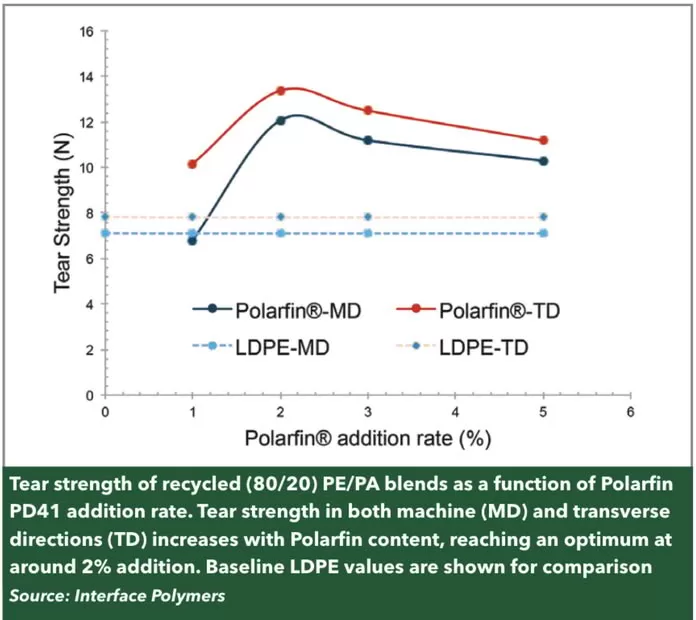
Interface Polymers’ Polarfin PD41 disperses incompatible polymers (PA, EVOH) into smaller, more uniform domains within PE matrices. In recycled PE/PA (80/20) blends, increasing Polarfin content from 0.5% to 5% reduced PA domain size from ~1.45 µm to ~0.35 µm, with haze decreasing from ~65% to ~30% and clarity improving from ~55% to ~80%. Tear strength in both machine and transverse directions peaks at ~2% addition, achieving improvements of 50–70% over untreated blends.
SK Functional Polymer’s Lotader AX8850 (ethylene-glycidyl methacrylate copolymer) compatibilises PE contamination in PET. At 5 wt% addition to an 80/20 PET/PE blend, elongation at break increases from 2% to 41%, and Charpy notched impact resistance rises from 1 kJ/m² to 9 kJ/m² at room temperature (and 0.8 to 5.5 kJ/m² at –30°C).
Lotader 3410 (ethylene-butyl acrylate-maleic anhydride) efficiently compatibilises PE into PA. At 10% addition to a 75/25 PA/PE blend, elongation at break and low-temperature impact strength increase substantially, restoring PA properties degraded by low PE levels.
Bio-based and circular compatibilisers
Sustainability innovations include bio-based options with mass balance certification:
- Kraton CirKular+ ReNew Series: Derived from pine wood pulping by-products; ISCC Plus certified at facilities in Belpre, Ohio (2024) and Berre, France (2021)
- The Compound Company’s Yparex RENEW OH17: Bio-based maleic anhydride-grafted PE (bioMAPE) for coupling fillers and polyolefins
- Kenrich Petrochemicals’ Ken-Reax KR PTOA: Titanate coupling agent from American pine-tree-based oleic acid (experimental, EPA TSCA registration pending)
| Product | Chemistry | Key Application | Performance Highlight |
|---|---|---|---|
| Polarfin PD41 | Diblock copolymer | PE/PA, PE/EVOH multilayer films | Clarity improvement (55%→80%), haze reduction (65%→30%) |
| Lotader AX8850 | E-GMA copolymer | PET/PE blends with contamination | Elongation increase (2%→41%) with 5 wt% loading |
| Lotader 3410 | E-BAc-MAH terpolymer | PA/PE blends | Impact strength restoration (up to 50–70% improvement) |
| CirKular+ C1000/C1010 | Styrenic block copolymer | PE flexible films with EVOH/PA | APR Critical Guidance Recognition for recyclability |
| Yparex RENEW OH17 | Bio-based MAH-grafted PE | Clay and fiber composites with polyolefins | Improved filler adhesion in recycled systems |
Table notes: E-GMA = ethylene-glycidyl methacrylate; E-BAc-MAH = ethylene-butyl acrylate-maleic anhydride; APR = Association of Plastic Recyclers.
Advanced compatibilisation approaches
Kenrich Petrochemicals’ Ken-Reax CAPS KPR uses titanium-aluminum (Ti-Al) chemistry to catalyze in-melt repolymerization and copolymerization of mixed recycled polymers. Dosed at 1.5–1.75% by weight (masterbatch form), it enables compatibilization of all polymer types (1–7) without delamination at any blend ratio. The additive also acts as a coupling agent for organic/inorganic fillers. Mixing conditions must be optimized (temperature typically lowered by ~10%) to maintain necessary shear rates for reactive compounding.
Dow’s Fusabond and Elvaloy systems provide both reactive and non-reactive compatibilisers. Elvaloy PTW in PET-PE tray waste acts as a coupling agent, enabling PE-contaminated PET to be processed into fibers at higher draw ratios (impossible without the additive). Versions with circular content (CIR) and bio-circular content (REN) use mass balance approaches and are ISCC Plus certified, appealing to automotive OEMs targeting carbon-neutral, circular plastics.
Clariant’s Licocene wax additives compatibilise PE/PP PCR blends (Licocene PP 1602, 2602, 3602), improving melt viscosity stability and processing smoothness. Licocene PE MA 4351 and PP MA 6452 serve as coupling agents for fillers in recycled HDPE and PP.
BYK’s SCONA TSPP 10213 GB (>2% grafting level, PP copolymer) excels in wood-plastic composites even with incompatible PE/PP recycleate mixtures. Unlike glass fibers, recycled carbon fibers often lack PP-compatible sizing; SCONA significantly enhances composite strength in such systems.
Regulatory recognition
Kraton’s CirKular+ C1000 and C1010 received APR Critical Guidance Recognition for PE films with up to 5% EVOH (2% loading) and up to 10% PA 6 (3% loading), respectively. Ingenia Polymers’ InCircle IP 1601 received APR recognition for multilayer PE films with PA/EVOH and is undergoing RecyClass certification in Europe for expanded film producer adoption.
Recycler Database and Market Infrastructure
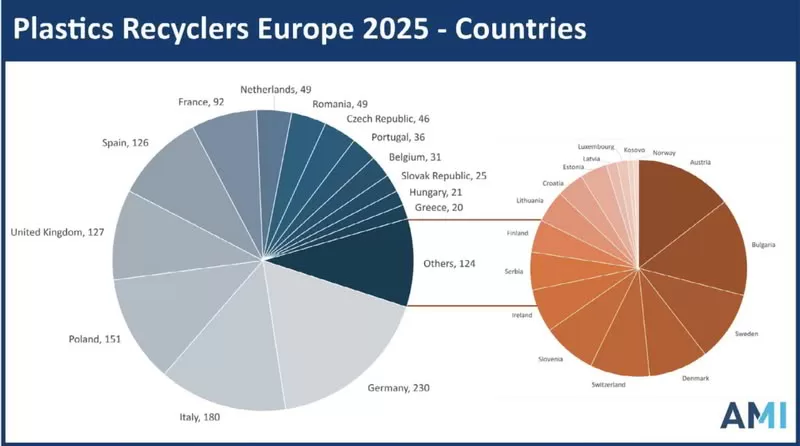
AMI’s Plastics Recyclers Europe 2025 database (7th edition) provides verified contact and operational data for 1,307 mechanical recycling plants across Europe. Compiled through systematic telephone interviews over eight months, it represents the most reliable industry intelligence available.
Geographic distribution
| Country | Number of Recyclers |
|---|---|
| Germany | 230 |
| Italy | 180 |
| Poland | 151 |
| United Kingdom | 127 |
| Spain | 126 |
| France | 92 |
| Netherlands | 49 |
| Romania | 49 |
| Czech Republic | 46 |
| Portugal | 36 |
Countries like Germany, Italy, UK, France, Belgium, and Netherlands operate robust recycling systems; others face lower recycling rates. External pressures (rising energy costs, stringent regulations, cheaper imports) have triggered announcements of plant closures, such as Cedo Recycling in the Netherlands.
Managerial contact distribution
The database includes up to four managerial contacts per plant with job titles:
- General Manager (GM): 897 contacts
- Sales: 445 contacts
- Production: 340 contacts
- Purchasing: 147 contacts
Database benefits include pre-populated Excel formats for CRM systems, prospect list enhancement with key decision-maker details, and streamlined lead generation.
Industry Events and Knowledge Sharing
Plastics Recycling Technology North America Conference
Held June 10–11, 2025 in Long Beach, California, this conference bridges the gap for technical knowledge sharing across the value chain. Key topics include:
- Market outlook: State of plastics recycling, policy roles, supply-demand interconnections, and recycler perspectives
- PCR quality improvements: Monitoring technology, additives, high-quality integration case studies, closed-loop color correction, and recycling infrastructure innovation
- Feedstock security: Multi-stakeholder partnerships for infrastructure scaling, public policy impact, and case studies
- Film and flexible packaging recycling: Best practices for contamination reduction, material quality improvement, and advanced recycling’s complementary role
Speakers include representatives from major organizations (Association of Plastic Recyclers, Kraft Heinz, Altium Packaging, Invista, Revolution, Dover Chemical, Polyfit, Ampacet, LyondellBasell, American Chemistry Council, The Recycling Partnership, and Titus MRF Services).
Chemical Recycling and Feedstocks Conferences
June 24–26, 2025 in Brussels: Conference on advanced/chemical recycling exploring waste plastics-to-materials conversion, with industry leaders addressing technological, legislative, and economic factors.
June 24, 2025 in Brussels: Feedstocks for Plastics Recycling event examining key challenges and drivers in waste management impacting feedstock supply for European recyclers.
Bioplastics and Circular Packaging Innovation
Amazon’s vision for recyclable bioplastics
Amazon’s long-term packaging objective is creating plastics that are bio-based, biodegradable, and easily recyclable, combining the sustainability benefits of each attribute. Current barriers include sorting and recycling technology limitations; Amazon invests in development through two projects:
EsterCycle (Colorado, USA): A startup co-founded by Julia Curley from the NREL BOTTLE consortium team. Uses methanol solvent and catalyst to deconstruct mixed polyester plastics (PET, PLA, PBAT) into building blocks for separation and purification. Tolerant to contaminants and additives typical in PCR, with planned pilot plant scaling.
Glacier (San Francisco, USA): Develops AI-enabled robotic sortation for MRFs. Uses camera vision with granular detection to identify bioplastics packaging in real MRF environments. Research focuses on design factors making packaging easier to detect and sort, even when crumpled or torn—insights applicable to Amazon and broader industry packaging design.
Certifications and partnerships
TERRIFIC project (NeXt genERation circulaR bio-based Flagship packaging): EU public-private partnership (2024 onwards) coordinated by Novamont, developing bio-based materials and packaging.
Amazon’s pilot: Bio-based bags for Amazon Fresh grocery delivery in Spain made from Novamont’s Mater-Bi (biodegradable bioplastic from corn starch, vegetable oil). Bags protect against spills and condensation, are compostable, and can be mechanically recycled in a closed-loop system through Amazon driver returns.
Key Industry Metrics and Trends
Recycled content growth
Ameripen’s US Packaging Recycled Content Goals Analysis (updated 2024) reveals:
- Post-consumer recycled (PCR) content in plastic packaging more than doubled: 5.3% (2019) → 10.7% (2023) among companies with stated goals
- Gap analysis: Despite added reclamation capacity, the US will fall short of 2025 plastics packaging goals (especially PET) unless collection rates and advanced recycling capabilities increase
Consumer preferences
Amcor’s 2025 European consumer research (3,351 respondents across UK, Italy, France, Germany, Sweden, Poland):
- 84% check on-pack disposal instructions
- Recyclability claims are the most influential factor affecting purchasing decisions
- More important than carbon footprint claims, despite “global warming” ranked as top environmental concern
Greenwashing corrections
Coca-Cola revised recycling-related claims on European plastic bottles following a European Consumer Organisation (BEUC) 2023 greenwashing complaint. New messaging clarifies: “I’m a bottle, excluding label and cap, made from 100%/50% recycled plastic.” Acknowledges that 100% recycling rates are unattainable and aims to reduce “infinite closed-loop recycling” messaging myths.
Advanced Recycling and Chemical Processing
BUSS ChemTech’s flash pyrolysis process converts mixed and contaminated plastic waste into raw material feedstock, complementing mechanical recycling where it reaches limits. The circular flow integrates mechanical recycling and dissolution technologies alongside flash pyrolysis, reducing reliance on incineration, landfill, and leakage pathways.
Trinseo and MagREEsource MOU (Memorandum of Understanding): Combines Trinseo’s proprietary polymer dissolution recycling with MagREEsource’s rare-earth magnet recycling. Trinseo’s process extracts polycarbonate (PC) from end-of-life products with minimal sorting; non-PC components (including magnets) are recovered via MagREEsource’s circular magnet-to-magnet model. MagFactory construction anticipated end of 2026.
Carbios: French enzymatic recycling company delayed construction of its first PET facility in Longlaville, US by 6–9 months pending additional financing. Plans cost-cutting, reorganization, and supplier renegotiations to complete within budget.
Notable Infrastructure and Investment Highlights
Boretech (Taiwan): Signed contract with LNJ Greenpet (Bhlwara subsidiary) to supply food-grade PET recycling and washing systems for Rajasthan project. Expected output: 100,000 tonnes/year; investment ~$4.41M; 95-acre facility creating 750 jobs by September 2026 production start.
Stadler Anlagenbau: Completed design and installation of Republic Services’ polymer recycling centre in Indianapolis, Indiana (second facility after Las Vegas, 2023). Two-line system with WireX bale opener; 5.5 and 5 tonnes/hour capacity for PET and mixed plastics respectively. Produces high-quality, food-grade recycled plastics for new bottles and containers.
BlueAlp pedestrian bridge (Panama Canal): Built using 3+ tonnes of recycled plastic over 81 meters, connecting four communities. Commissioned as part of Bladex’s ESG strategy (second such bridge; first in Kosovo, Puerto Caimito, 2023).
Summary: Future Directions
The plastics recycling industry is undergoing multifaceted transformation driven by:
- Regulatory pressure: EU PPWR, WEEE, ELV targets, and US policy initiatives
- Technology maturation: Compatibiliser innovations, chemical recycling scale-up, AI-enabled sorting
- Feedstock strategy: Deliberate PIR-PCR blending to meet corporate and regulatory recycled content targets
- Circular economy integration: Bioplastics, enzymatic recycling, and closed-loop design frameworks
- Infrastructure investment: Major companies and consortiums funding MRFs, processing plants, and pilot facilities globally
Key takeaway: The industry is transitioning from a linear “take-make-dispose” model toward a circular ecosystem where post-industrial waste, contaminated streams, and complex multi-material packages can be economically converted into high-quality feedstock for new products—supported by regulatory clarity, technological advances, and multi-stakeholder collaboration across the value chain.