In the high-stakes world of strategic commodities, the market occasionally witnesses a “black swan” event that defies conventional economic logic. As the market trend move into 3rd quarter of 2026, the market for Antimony, frequently referred to in trade circles simply as “Ti”, has transformed into a jarring landscape of “Ice and Fire.”
On one hand, the market is seeing a “fire” in the domestic appetite for raw materials, with imports surging at a pace that suggests a desperate scramble for supply. On the other, the international trade of processed Antimony has entered a deep freeze, with exports of key products like Antimony Ingots effectively vanishing. This divergence isn’t just a market fluctuation; it is a profound structural mystery that signals a fundamental shift in global supply chains.
The Import Surge: An Aggressive Global Supply Grab
The “fire” in this market is fueled by an insatiable demand for raw Antimony ore and gold-antimony concentrates. In May 2026, imports reached a staggering 10,972.3 tons, representing a massive 375.8% increase year-over-year. Even though this represented a slight 19.5% month-on-month dip, the cumulative momentum is undeniable.
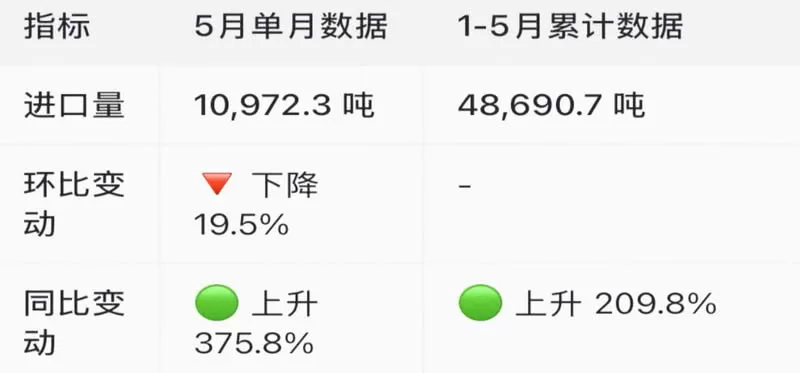
According to the latest trade figures, the year-to-date (January–May) cumulative imports have surged by 209.8%. While the source data reports a cumulative figure of 4,869 tons—an anomaly considering May’s single-month total exceeded 10,000 tons—the trajectory remains clear: the domestic market is acting as a global vacuum for raw ore.
The list of suppliers reveals a fascinating shift in procurement:
- Thailand: 16,772.3 tons
- Bolivia: 3,940.4 tons
- Chad: 2,440.9 tons
- Spain: 715.7 tons (notably jumping from zero last year)
- Myanmar: 199.2 tons
The entry of Spain as a significant supplier is particularly noteworthy for a strategist. This likely indicates a redirection of European stockpiles or a new processing arbitrage, suggesting that traditional supply routes are being bypassed in favor of direct “supply grabs.”
The Great Export Freefall and the Thailand Paradox
Contrast this with the “ice” on the export side. The transition has been abrupt. May’s exports plummeted to just 193.2 tons, a 49.1% month-on-month decline. Even more startling is the cumulative January–May export figure of 187.9 tons.
(Strategist’s Note: There is a clear reporting discrepancy in the raw data, as a five-month cumulative figure of 187.9 tons is mathematically impossible if May alone saw 193.2 tons. However, this anomaly itself reflects a market in such high volatility that reporting mechanisms are struggling to keep pace with the collapse.)
The collapse is driven by a massive retreat from major global buyers:
- Mexico: Orders slashed by 81.4%
- Vietnam: Orders slashed by 80.8%
- Thailand: Orders slashed by 71.9%
This creates what I call the “Thailand Paradox.” How can Thailand be the market’s largest supplier of raw material (16,772.3 tons) while simultaneously cutting its intake of finished products by over 70%? This circular trade red flag suggests that Southeast Asian hubs are purging their raw reserves while their own industrial demand for finished Antimony has hit a wall. As the market sentiment puts it:
“Imports are rising to the sky, and exports are falling to the ground.”
The “Zero Export” Mystery of Antimony Ingots
The most chilling aspect of the “Ice” is found in the sector for Antimony Ingots. In May, exports of these processed ingots were exactly zero. This is not a one-month fluke; the cumulative export figure for the first five months of 2026 is also zero.
For a major commodity component to essentially vanish from the international export market for five consecutive months is unprecedented. It suggests that the “fire” of domestic imports is being used to feed an internal furnace. The domestic market is “swallowing” every ton of raw material and refusing to let a single processed ingot leave the country. This indicates either a total breakdown in international price parity or, more likely, a mandate to prioritize domestic requirements above all else.
The Russian Exception: A Strategic Outlier
Amidst this general collapse, Russia has emerged as the “sole survivor” and the only major partner showing growth. While every other major buyer—from Mexico to Vietnam—is in a state of retreat, exports to Russia hit 716 tons, a 93.8% increase.
This is the most significant geopolitical signal in the report. Antimony is a critical hardening agent for lead and is essential in the production of ammunition and various defense-industrial applications. Russia’s aggressive intake, contrasted against the global “freeze,” suggests a targeted “sanction-proofing” strategy and a heightened military-industrial requirement that outweighs current global economic headwinds.
Conclusion: Hoarding Strategy or Demand Collapse?
The 2026 Antimony market presents a classic tension between massive resource accumulation and a total cessation of international outflow. While some may argue we are seeing a catastrophic collapse in global demand, the 375% surge in imports suggests otherwise. You do not buy raw ore “like a tiger” if there is no use for it.
The evidence points toward a massive, strategic hoarding phase. By absorbing global supply while “flatlining” exports of processed ingots, the domestic market is building a fortress of strategic reserves.
The question for the second half of 2026 is no longer about price; it is about how many capabilities to access the supply chain. As the “Ice and Fire” dynamic hardens, we must ask: In a world where strategic metals are being locked behind domestic borders, how much longer can the global supply chain survive on the scraps of the Russian exception?